Three filters cover most field and emergency scenarios. The Sawyer Squeeze (0.1 micron absolute, 3 oz, rated to 100,000 gallons) is the bug-out filter. The Big Berkey (a 2.25-gallon countertop gravity system, 3.5 gallons per hour with two elements) is the home filter. The LifeStraw Personal (0.2 micron straw, rated to 4,000 liters) is the cheap backup. Each solves a different problem, and none of the three is certified to remove viruses. This is a companion to water purification without boiling, which covers all seven field methods.
Which Survival Water Filter Should You Buy?
| Use case | Best filter | Why |
|---|---|---|
| Bug-out bag / day pack | Sawyer Squeeze | 3 oz, 100,000-gallon rating, fits bottles, pouches, and hydration hoses |
| Base camp / shelter-in-place | Big Berkey | 3.5 gal/hr with two elements, no power, no pumping |
| Budget backup / emergency kit | LifeStraw Personal | 1.6 oz straw for drinking straight from a source |
| International / post-flood (virus risk) | Sawyer + chemical tablets | Filter removes protozoa and bacteria; chemical treatment handles viruses |
| Long-term home water security | Big Berkey | Highest throughput, 5,500 gallons per Phoenix element pair |
How Do Popular Survival Water Filters Compare?
Every figure below is the maker’s own rating from its product or help pages. A dash means the maker’s page we checked did not state the figure. Rated life assumes clean water; silty water shortens it.
| Filter | Type | Removes viruses? | Flow rate | Rated life | Weight |
|---|---|---|---|---|---|
| Sawyer Squeeze | Hollow fiber, 0.1 μm absolute | No | – | 100,000 gallons | 3 oz |
| Sawyer Mini | Hollow fiber, 0.1 μm absolute | No | – | 100,000 gallons | 2 oz |
| LifeStraw Personal | Straw, 0.2 μm membrane | No | 2.1 L/min | 4,000 L (1,000 gal) | 1.6 oz |
| LifeStraw Peak Series Straw | Straw, 0.2 μm membrane | No | 2.5 L/min | 4,000 L (1,000 gal) | 2.3 oz |
| Katadyn BeFree 1.0L | Hollow fiber, 0.1 μm | No | Up to 2 L/min | Up to 1,000 L | – |
| MSR Guardian | Pump purifier | Yes (meets NSF P248) | 2.5 L/min | 10,000+ L | 1 lb 1 oz |
| Platypus GravityWorks 4L | Hollow fiber gravity | No | 1.75 L/min | 1,500 L | 11.5 oz |
| MSR MiniWorks EX | Ceramic pump | No | 1 L/min | 2,000 L | 1 lb |
| Big Berkey | Countertop gravity, 2.25 gal | NSF/ANSI 42 only (taste, chlorine) | 3.5 gal/hr (2 elements) | 5,500 gal per Phoenix pair (maker) | – |
What Do Micron and Log-Reduction Ratings Mean?
A micron rating is the pore size of the filter membrane. Pathogens come in three size classes, and size decides whether a filter physically blocks them:
- Protozoa (Giardia 6 to 10 microns, Cryptosporidium 4 to 6 microns): blocked by both 0.1 and 0.2-micron membranes.
- Bacteria (E. coli, Salmonella, Campylobacter), 0.2 to 10 microns: blocked by both 0.1 and 0.2-micron membranes.
- Viruses (norovirus, hepatitis A), 0.02 to 0.3 microns: pass through standard 0.1 and 0.2-micron hollow-fiber filters. They need chemical treatment, UV, or a filter rated for virus removal.
Log reduction measures how much of a pathogen a filter removes, one order of magnitude per log. A 3-log filter removes 99.9%; a 6-log filter removes 99.9999%. The usual targets are 3-log for protozoa and 6-log for bacteria.
The gap between 0.1 micron absolute (Sawyer) and 0.2 micron (LifeStraw) matters only at the margin, for the smallest bacteria. Both protect against the realistic backcountry threats. Neither removes viruses.
Sawyer Squeeze: Best for Bug-Out and Field Use
Sawyer rates the Squeeze at 0.1 micron absolute, removing 99.99999% of bacteria and 99.9999% of protozoa. The specs that matter in the field:
- Weight: 3 oz (85g)
- Rated life: up to 100,000 gallons, a lifetime supply for one person
- Cleaning: backflush with the included cleaning plunger whenever flow drops; in silty water that can mean every 20 to 30 liters
- Fit: screws onto standard 28mm bottle threads (Smartwater bottles are the usual pairing)
You can drink straight from a pouch, filter into a bottle, run it inline between a dirty bag and a clean bottle, or fit it into a hydration bladder hose. That versatility is why it is the standard survival and backpacking pick.
Critical failure mode: freezing. If a hollow-fiber filter freezes, the membranes can crack in ways you cannot see or test in the field. The filter flows normally while letting unfiltered water through. In freezing weather, keep it inside your sleeping bag, a jacket, a sock, or a truck cab. If a filter froze, or you are not sure, replace it.
The Sawyer Mini uses the same 0.1-micron rating and 100,000-gallon life in a smaller 2 oz housing. It flows slower and needs backflushing more often. The Squeeze is the better primary filter; the Mini works as a backup or in a gram-counting ultralight build.
LifeStraw Personal and LifeStraw Go: The Entry-Level Options
The LifeStraw Personal (the original straw) uses a 0.2-micron membrane rated to 4,000 liters (1,000 gallons). It is the cheapest personal filter, and its limits are real:
- Straw only: you drink directly from the source. It cannot filter into a container or fill a bag.
- Rated life of 1,000 gallons vs the Sawyer’s 100,000. The LifeStraw is a consumable; the Sawyer is not.
- No backflush: when flow drops, the filter is done.
The LifeStraw Go puts a membrane filter, also rated to 4,000 liters, inside a 650mL bottle. You fill and drink from one vessel, which fixes the straw’s main limit. It suits one person, not a group.
At the Go’s price, the Sawyer Squeeze is the better buy for most people: far longer rated life, more ways to attach it, and a cleaning plunger. Keep a LifeStraw Personal as a cheap backup, not a primary system.
Big Berkey: Best for Base Camp and Shelter-in-Place
The Big Berkey is a countertop gravity filter for a home or base camp, not for carrying. The maker’s ratings:
- Capacity: 2.25 gallons (8.5 liters)
- Output with 2 elements: up to 3.5 gallons per hour, measured with the upper chamber full; it slows as the level drops. The housing takes up to 4 elements.
- Elements: new systems ship with Phoenix elements made in India, in place of Black Berkey, which Berkey lists as limited supply. The maker rates Phoenix at 5,500 gallons per pair (Berkey).
- Housing: stainless steel
For the Phoenix elements, Berkey says it is “not making microbiological claims” and tells buyers to disinfect questionable water first. Its only certification listing we found is NSF/ANSI 42, which covers chlorine, taste and odor. The chemical removal claims rest on the company’s own lab tests. Full detail: Berkey vs LifeStraw and Berkey vs Sawyer. The red dye test some owners run (red food coloring in the top chamber, check the output) only shows that large particles are blocked. It says nothing about viruses or chemicals. If virus contamination is possible, treat Berkey output with bleach as you would any other filtered water.
For a stationary emergency (power outage, grid down, contaminated city water), the Berkey beats portable filters on throughput and needs no power. Carried more than 4 miles, it does not compete.
LifeStraw vs Berkey: Home Gravity Filter or Personal Straw?
These two answer different questions, and the household math shows it. Ready.gov’s planning figure is one gallon per person per day. For a family of four, that is 4 gallons a day.
| Question | Big Berkey (2 elements) | LifeStraw Personal |
|---|---|---|
| Time to filter 4 gallons | 4 ÷ 3.5 gal/hr = about 70 minutes, unattended | Cannot fill a container; drinking only |
| How long the filter lasts at 4 gal/day | 5,500 ÷ 4 = 1,375 days, about 3.8 years (Phoenix pair) | One straw per person: 1,000 gal ÷ 1 gal/day = 1,000 days, if used for every gallon |
| Water for cooking and washing | Yes, collects in the lower chamber | No |
| Carry it while evacuating | No | Yes, 1.6 oz |
| Virus removal you can verify | No independent certification | No |
The decision: if you are staying home, a LifeStraw cannot supply a household, because it cannot put water in a pot. If you are leaving, a Berkey stays on the counter. Most households that plan for both end up with a gravity filter at home and a Sawyer or LifeStraw in each bag.
Are Gravity Filters Worth It for Camp and Home?
Gravity filters (Platypus GravityWorks, Sawyer Gravity, MSR AutoFlow, and the Berkey) need no pumping or sucking. Hang the dirty bag and water drips through the filter into the clean one. They suit:
- A camp where you filter 4 liters at a time without watching it
- Households drawing from a rain barrel or stream during a long outage
- Groups that need many liters a day without one person working a pump
Silty water slows any filter. Pour turbid water through a bandana or coffee filter first to protect the hollow fiber and keep the flow up.
When Do You Need to Add Chemical Treatment?
For North American wilderness water, a hollow-fiber filter alone is usually enough, because most backcountry sources do not carry human-source viruses. For post-disaster city water, floodwater, or international travel, viruses are possible. Use two stages:
- Filter first, to remove sediment, bacteria, and protozoa.
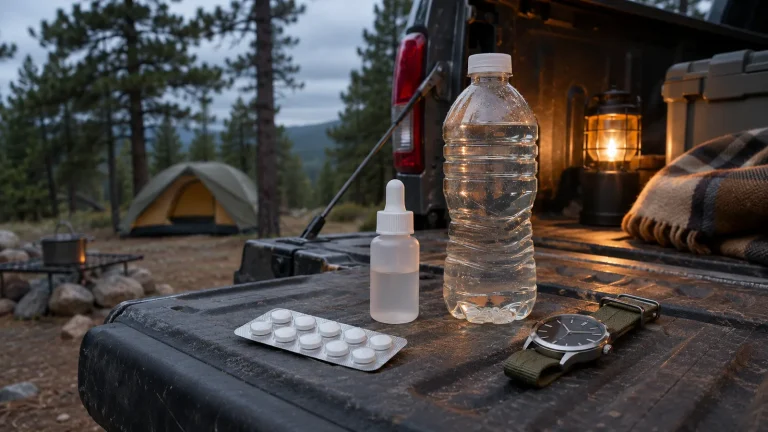
- Then treat the filtered water with chlorine dioxide tablets, Aquatabs (sodium dichloroisocyanurate), or iodine to handle viruses. Tablet strengths differ by product, so dose by the label.
Dosages and contact times are in chemical water treatment: iodine, chlorine, and chlorine dioxide dosages.
Where to Go Next
All seven treatment methods, including UV and solar SODIS, are compared in water purification without boiling. The no-gear solar method is in solar SODIS water purification. To depend less on filtering at all, build a stored supply with emergency water storage: how much to store, safe containers, and treatment.