
Power outage gear: the 9 items the agencies name
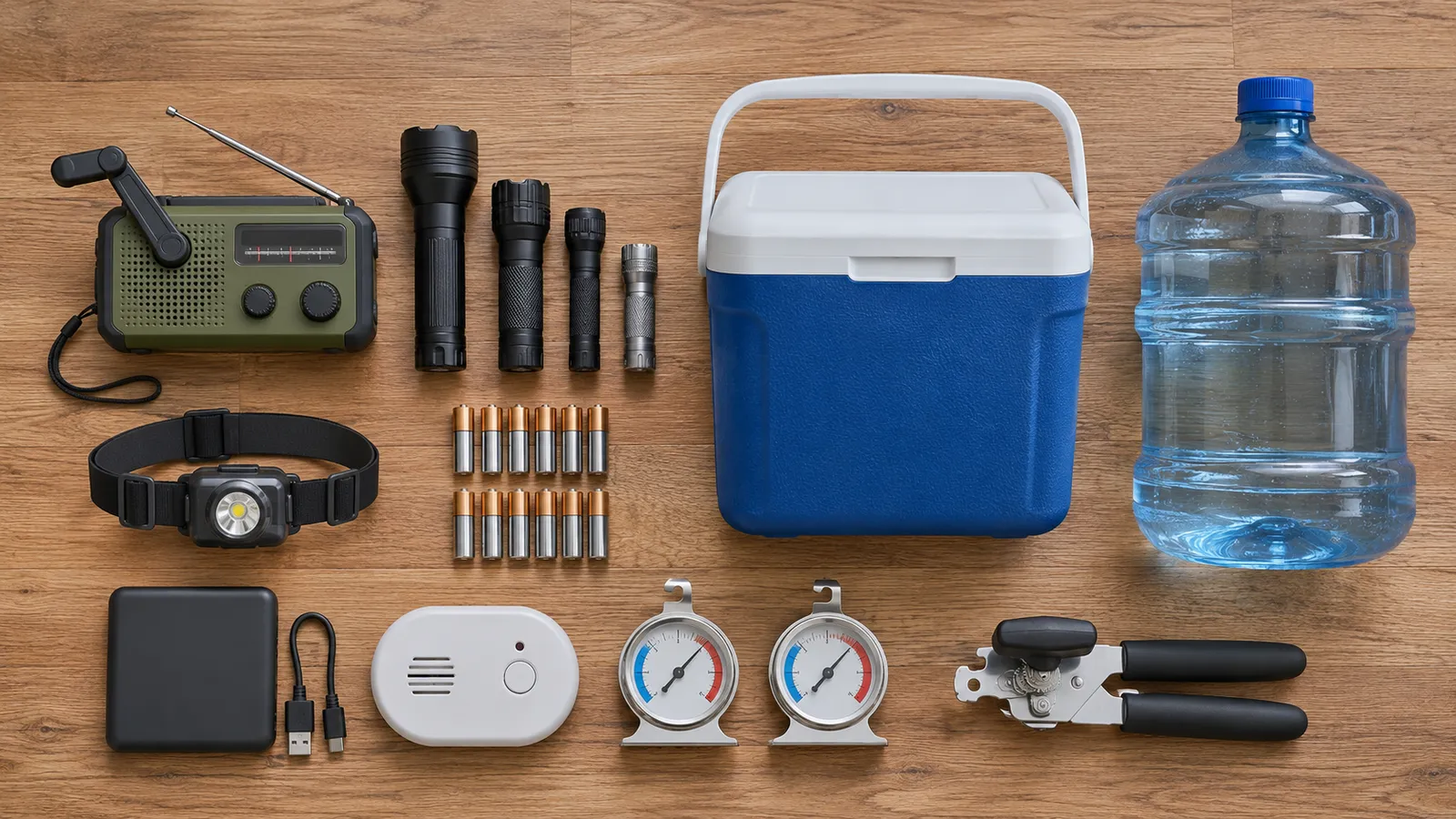
Ready.gov’s kit and power-outage pages name these 9 items for when the power goes out, from fridge thermometers to a carbon monoxide alarm with battery backup. Each one below comes with the official line behind it, what it means for your home, and what happens without it.
As an Amazon Associate I earn from qualifying purchases.
1. Fridge and freezer thermometers
The rule: Ready.gov says to “Monitor temperatures with a thermometer” and to throw out food at 40 degrees or higher. FoodSafety.gov gives the fridge 4 hours with the door shut.
What it means at home: The clock tells you when to check. Only the thermometer tells you what to keep. You need two, one in the fridge and one in the freezer, and they have to be in place before the power goes out.
If you skip it: With no reading, the safe rule is to throw the food out, including food that stayed cold.
2. A cooler
The rule: Ready.gov says to “Use coolers with ice if necessary.” The fridge holds for 4 hours (FoodSafety.gov).
What it means at home: If the outage looks long, move milk, meat and medicine that needs cold into a cooler with ice before hour 4, not after.
If you skip it: Past hour 4, refrigerated meat, poultry, fish, eggs and leftovers go in the trash.
3. One flashlight per person
The rule: Ready.gov: “Have flashlights for every household member” (Power Outages).
What it means at home: Count heads, not rooms: a family of four needs 4. A headlamp counts and leaves both hands free.
If you skip it: One shared flashlight leaves everyone else in the dark the moment someone walks off with it.
4. Extra batteries
The rule: Ready.gov’s kit list: “Extra batteries” (Build a Kit).
What it means at home: Check what size your flashlights and radio take before you buy. Buy that size, and store the spares next to the lights.
If you skip it: Spares in the wrong size are no use in the dark.
5. A battery or hand-crank radio
The rule: Ready.gov’s kit list: “Battery-powered or hand crank radio and a NOAA Weather Radio with tone alert” (Build a Kit).
What it means at home: Get a radio that does both, so one device covers news and weather alerts. The tone alert sounds on its own, even overnight.
If you skip it: When the phone network is down, a radio is how official updates reach the house.
6. A phone backup battery
The rule: Ready.gov’s kit list: “Cell phone with chargers and a backup battery” (Build a Kit).
What it means at home: Keep it charged and in the kit. Put the phone in low power mode the moment the power goes, as Ready.gov advises.
If you skip it: A dead phone means no texts, no flashlight app and no 911.
7. A carbon monoxide alarm with battery backup
The rule: Ready.gov: “Install carbon monoxide detectors with battery backup in central locations on every level of your home” (Power Outages).
What it means at home: Count your levels. A two-story house with a basement needs 3. Ready.gov specifies battery backup for a reason: a plug-in alarm has no power during an outage, and that is when generators and camp stoves come out.
If you skip it: Carbon monoxide has no smell. The alarm is the only warning you get.
8. Water containers
The rule: Ready.gov: “one gallon per person per day for several days” (Build a Kit). The CDC says to replace water you stored yourself every 6 months.
What it means at home: A family of four needs 12 gallons for 72 hours (4 × 1 × 3). That is 3 five-gallon containers. A full week is 28 gallons, or 6 containers. Write the fill date on each one.
If you skip it: Water you store with no date on it goes unrotated, and then you can’t tell whether it’s still good.
9. A manual can opener
The rule: Ready.gov’s kit list: “Manual can opener (for food)” (Build a Kit).
What it means at home: Keep one in the kit even if the kitchen has an electric opener.
If you skip it: An electric opener doesn’t work in an outage, so the canned food stays sealed.
Then make the plan
Gear covers the supplies. The free Power Outage Survival Guide covers what fails at home, hour by hour. The 72-Hour Readiness Kit turns it into printed checklists and fridge cards, for $27.
How this list was made: compiled on 14 November 2026 from Ready.gov’s Build a Kit (updated 1 July 2026) and Power Outages (updated 4 June 2026), the CDC’s emergency water supply page and FoodSafety.gov’s power outage chart. The household counts are our arithmetic.