Trapping produces food while you sleep. One properly placed trap working overnight outperforms hours of active hunting for small game. The return on investment in trap construction time is high — a figure-4 deadfall takes 20 minutes to build and can produce a squirrel or rabbit with no further effort. This guide covers 8 trap types, construction dimensions, placement logic based on animal sign, and the legal framework set by state wildlife agencies. For reading animal sign to find trap locations, see reading animal sign to find trap and snare locations.
Legal Overview: What’s Permitted Without a License
Trapping is regulated by each state’s wildlife agency (and by provincial agencies in Canada). The agency decides which devices are legal, which species may be trapped, in what season, and with what license. The examples below were checked against state rules and statutes in November 2026; rules change every season, so read your own state’s current regulations before you set anything.
- Wire snares: Banned or tightly limited in many states. New York says snares may not be used for trapping, Colorado’s constitution bans taking wildlife by snare, Missouri prohibits snares on land, and California counts snares as body-gripping traps that may not be used for recreation or commerce in fur. Where snares are legal, they come with a license and rules on size, placement, and species.
- Deadfall traps (figure-4, Paiute): Not a legal gray area. Several states prohibit deadfalls by name, including Missouri, Virginia, and Pennsylvania. Check your state’s list of prohibited methods before building one.
- Box traps (live traps): The least restricted category, but still regulated. Whether you need a license or permit, how often you must check the trap, and where you may release an animal all depend on the state and the species.
- Conibear body-gripping traps: Licensed and size-restricted where legal. Pennsylvania allows body-gripping traps only in water, and Washington bars body-gripping traps for recreation or commerce in fur.
- No survival exemption: Necessity is an affirmative defense argued in court after the fact, and it requires showing you had no reasonable alternative (Cornell LII). It is not a license, and it is no basis for practicing with snares or deadfalls.
Trap checks: States set how often traps must be checked. New York requires a check once every 24 hours in its Southern Zone and every 48 hours in parts of the Northern Zone, Pennsylvania requires a visit once every 36 hours, and Missouri requires most trapped animals to be removed or released daily. Leaving traps unchecked breaks these rules and leaves animals to suffer.
Target Species and Trap Selection
Small game trapping in North America targets three species that produce reliable returns: Eastern cottontail rabbit (Sylvilagus floridanus), fox squirrel and gray squirrel (Sciurus spp.), and muskrat (Ondatra zibethicus) in wetland areas. Larger targets (raccoon, beaver, mink) require appropriately sized traps and more skill to set effectively.
Wild rabbit and squirrel are very lean meat. We could not confirm a per-animal calorie figure from an authoritative source, so we do not quote one; USDA FoodData Central (fdc.nal.usda.gov) lists calories per 100 g of raw game meat if you need to plan around it.
Trap 1: Figure-4 Deadfall
The figure-4 deadfall is the most widely taught primitive trap, using three notched sticks to support a weighted rock or log that falls when the trigger stick is disturbed. It works — with practice and correct construction. The most common failure is incorrect trigger sensitivity and insufficient weight.
Construction:
- Upright stick: 12 inches long, pointed at the bottom to push into soil, notched at the top to receive the diagonal stick. The notch must be a square cut perpendicular to the stick — angled cuts make the trigger too sensitive or too stiff.
- Diagonal stick: 14–16 inches long, notched near the top to rest against the upright stick, notched at the middle to hold the bait stick. The diagonal stick leans at approximately 45° from vertical against the weight.
- Bait/trigger stick: 8–10 inches long, notched at one end to fit the diagonal stick notch, bait placed at the other end under the weight.
- Weight: No agency publishes a minimum; the US Army Survival Manual (FM 21-76) says only that it should be heavy enough to kill or incapacitate the prey immediately. For scale, the Missouri Department of Conservation lists gray squirrels at ¾–1½ lb and eastern cottontails at 2–3¼ lb. Flat sandstone, slate, or a heavy log are the best weights — irregular-shaped rocks are unreliable. Test by pressing on the bait stick — the weight should fall cleanly without binding.
Placement: Along a game trail with the bait stick positioned so the animal must reach under the edge of the weight to reach the bait. The weight should cover the approach path. Bait: peanut butter (highly effective for squirrel and mice), apple, dried corn, rolled oats.
Trap 2: Paiute Deadfall
The Paiute deadfall is a variation of the figure-4 that uses a short cord and a catch stick in the trigger. It uses four components: an upright stick, a diagonal stick, a toggle stick, and a short piece of cordage or sinew connecting the toggle to a small toggle that rests on the ground.
The US Army Survival Manual (FM 21-76) describes the Paiute as easier to set than the figure-4. Like every deadfall, it is prohibited in several states; see the legal overview above.
Trap 3: Wire Snare
Wire snares are the most efficient trap per unit of time to set — a properly positioned snare takes 5 minutes to install and produces high catch rates on active rabbit and squirrel runs. The snare constricts around the animal’s neck as it passes through, killing quickly through hanging or constriction.
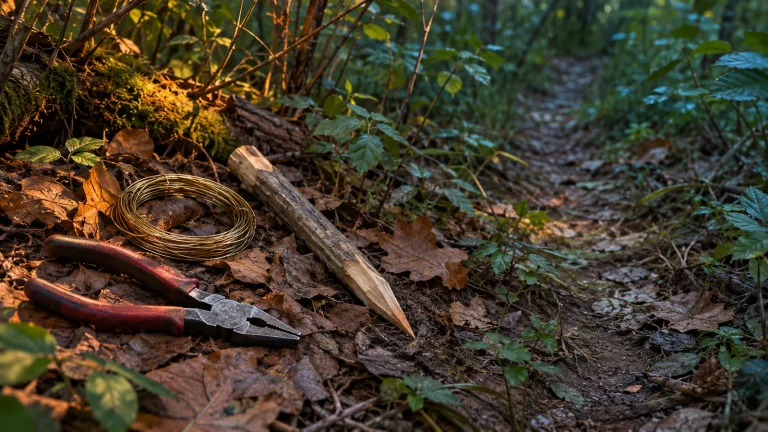
Wire specification: 24-gauge galvanized wire (0.51mm) for rabbit; 28-gauge (0.32mm) for squirrel. Lighter wire breaks; heavier wire is difficult to form into a tight loop and is visible. Hardware stores stock 24-gauge wire on spools. 100 feet of it weighs about 50 g plus the spool (derived: 0.51 mm diameter × 30.5 m × steel at 7.85 g/cm³) and makes 25 snares at 4 feet of wire each.
Loop dimensions by species:
- Rabbit: loop diameter 4 inches (10cm), loop bottom positioned 4 inches above the ground
- Squirrel (ground set): loop diameter 3 inches (7.5cm), positioned 3 inches above ground
- Squirrel (pole set, see below): loop 5–6 cm (about 2 inches) across, set about 2.5 cm (1 inch) off the pole, per FM 21-76
Anchor: The snare wire must be anchored to a fixed object — a stake driven 12 inches into the ground, a thick root, or a tree base. Anchoring to flexible branches allows the snare to move with the wind, producing false sets. Anchor stake: a forked stick with one fork driven into the ground and the snare wire attached to the other fork allows the snare loop to be positioned at the correct height without a separate support.
Trap 4: Squirrel Pole Snare
The squirrel pole is one of the most productive trap sets available. A straight pole 5–6 feet long is leaned against a tree known to be used by squirrels (look for claw marks on bark, nut caches at the base, and gnawed nut fragments). Multiple snares are placed along the pole — squirrels approaching the tree to cache nuts or access routes will attempt to climb the pole and walk through the snares.
The US Army Survival Manual (FM 21-76) says that after an initial period of caution, squirrels will try to go up or down the pole, and several can be caught on one pole. It places the top and bottom snares about 45 cm (18 inches) from the ends of the pole so the squirrel cannot get its feet on solid wood. Snaring squirrels is illegal wherever snares are banned; see the legal overview above.
Trap 5: Spring Snare
A spring snare uses a bent sapling or spring pole to jerk the snare upward when triggered, lifting the animal off the ground and preventing escape. More complex to set than a simple wire snare but more reliable on animals that may escape a ground snare by backing out.
Key dimensions: The spring pole must snap back hard enough to lift the target animal clear of the ground. We found no published force figure. Test by pressing down on the trigger — if the pole snaps back with force, it’s adequate. The trigger is a notched toggle set between a ground stake and the snare line — when the animal disturbs the snare, the toggle releases and the spring pole snaps upward.
Trap 6: Bottle / Funnel Trap (Fish and Small Animals)
A bottle or funnel trap uses an inverted funnel entrance that allows animals to enter but prevents them from backing out. For fish: a 2-liter plastic bottle with the top third cut off and reversed into the base creates an effective minnow trap. Place in current, bait with bread or peanut butter, and check every 12–24 hours. Small crayfish, minnows, and chubs are valuable protein even when larger game is absent. Traps for fish and crayfish fall under your state’s fishing regulations, so check them first.
Trap 7: Box Trap (Live Trap)
Commercial box traps (Havahart-style) catch animals alive and uninjured. Whether you need a license or permit for one depends on your state and the species. Hardware stores sell cage traps in sizes for squirrel-sized and rabbit-sized animals; match the size to the animal using the maker’s size chart. Bait: apple slices, carrots, peanut butter on cracker, or corn.
Trap 8: Conibear Body-Gripping Trap
The conibear (body-gripping) trap is designed to kill quickly by closing across the animal’s body when it is positioned correctly. It requires a license in most jurisdictions and must be positioned precisely to avoid bycatch (catching non-target species).
Sizes and targets: Conibear 110 for muskrat and mink; Conibear 120 for mink, weasel, and marten; Conibear 220 for raccoon and beaver. Check jaw sizes on the maker’s page. Some states restrict body-gripping traps on land; Pennsylvania allows them only in water.
Placement: Position the trap opening so the target animal must pass directly through the jaws to reach food or a den entrance — a natural chokepoint. Common sets: in a muskrat runway at the water’s edge (place the 110 underwater in the runway, 2–3 inches below surface); on a beaver dam at an active crossing; in a trail through dense vegetation where tracks show consistent use.
Trap Placement Strategy: Reading Sign Before You Set
A trap in a random location catches nothing. The same trap placed on an active run produces consistent catches. Before placing any trap, spend 20–30 minutes identifying game sign:
- Runs: Paths of compressed grass or soil maintained by consistent animal use. Runs narrow down to 6–8 inches wide for rabbit, 2–3 inches for squirrel. Vegetation on either side of the run is bent away at consistent height indicating the animal’s body width.
- Feeding sign: Gnawed nut fragments, stripped bark (rabbit and beaver), partially eaten berries, and digging at the base of trees all indicate active use of an area.
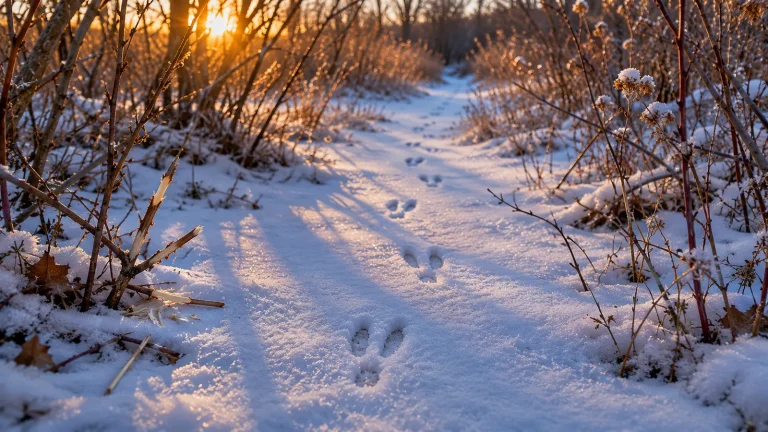
- Tracks: Soft soil near water, mud, and sand show tracks clearly. Fresh tracks (sharp edges, no drying or cracking) indicate the animal passed recently.
- Chokepoints: Natural constrictions where the animal must pass — a gap under a log, a path through a brush pile, a narrow passage between two trees — are the highest-percentage trap locations. The animal’s options are limited at a chokepoint, making precise trap placement easier.
Where to Go Next
Building the figure-4 deadfall with correct notch geometry, trigger sensitivity, and weight specifications is in figure-4 deadfall trap: construction, trigger adjustment, and placement. Wire snare setup including loop dimensions by species, anchor methods, and legal status by state category is in wire snare trapping: legal overview, setup, and animal targeting. Reading the specific animal sign patterns — runs vs. trails, feeding sign, bedding areas — that make trap placement reliable is in reading animal sign to find trap and snare locations. Food from trapping requires water — see water purification without boiling.