
Power outages: what fails at home, and when
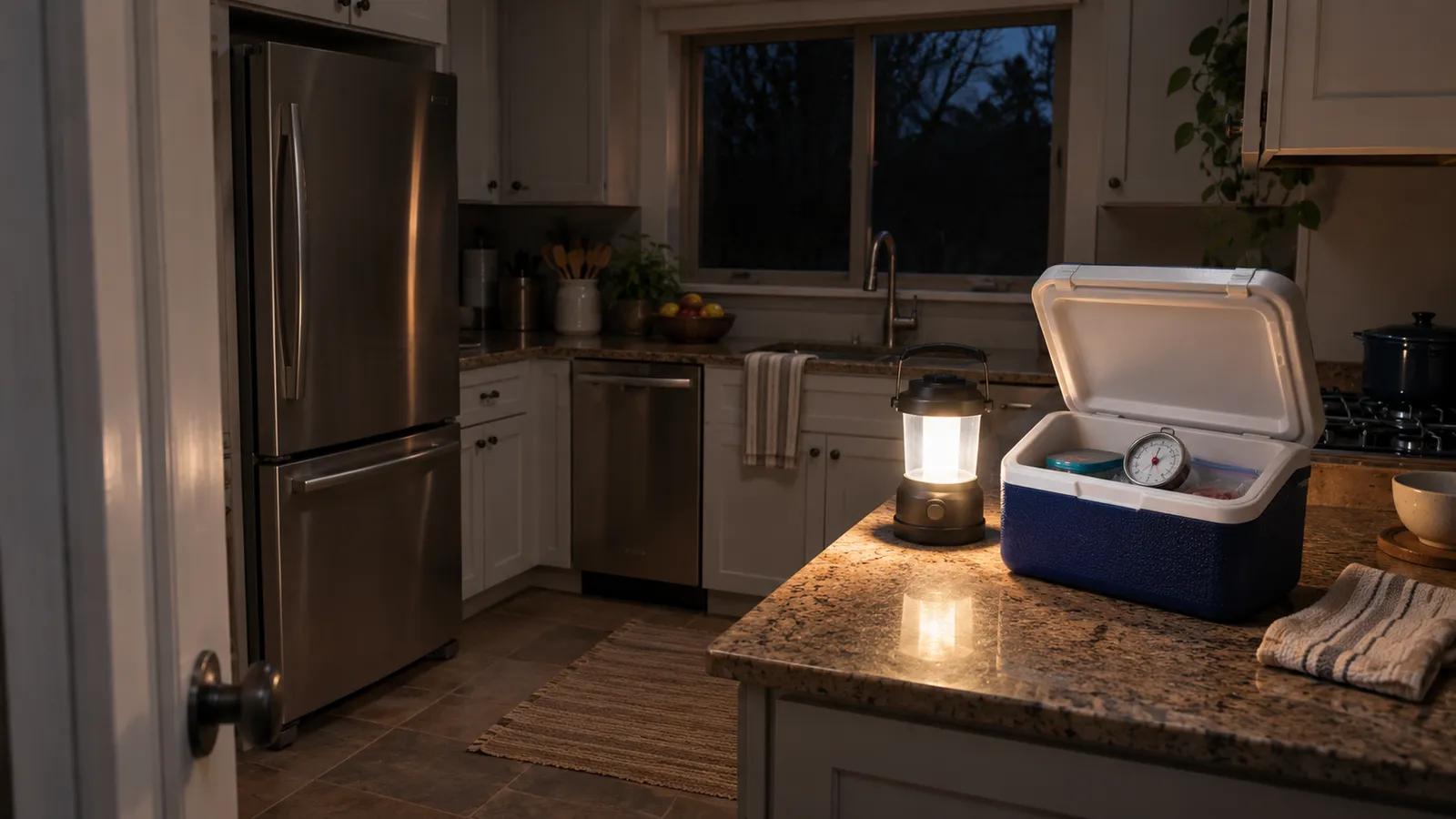
A power outage at home runs on three clocks: the fridge at 4 hours, the half-full freezer and refrigerated medicine at 24, and the full freezer at 48. Plan for 72 hours as the floor. Everything on this page hangs on those numbers.
Flashlights on. Keep the fridge and freezer doors closed.
Meat, poultry, fish, eggs and leftovers go after 4 hours without power (FoodSafety.gov).
A half-full freezer holds about 24 hours. Refrigerated medicine goes after a day unless the label says otherwise (Ready.gov).
A full freezer holds about 48 hours with the door shut.
A family of four has used 12 gallons of water at 1 gallon per person per day.
Get the free guide →
Food: the fridge and freezer
The fridge keeps food safe for up to 4 hours with the door closed. The freezer holds about 48 hours when full and 24 when half full (FoodSafety.gov). Ready.gov’s test is the temperature: throw out food at 40 degrees or higher. That means the thermometers have to be inside before the power goes out.
Full keep-or-toss rules: Power outage food safety.
Water
Ready.gov asks for 1 gallon per person per day (Ready.gov). For 72 hours that’s 3 gallons a person, 12 for a family of four. Ready.gov warns a regular water source can be cut off, and a well pump stops when the power does.
How to store it and how long it keeps: Emergency water storage. To treat water you didn’t store: Water purification without boiling.
Backup power and generators
Generators go outdoors only, at least 20 feet from windows, doors and attached garages (Ready.gov). Ready.gov also asks for carbon monoxide detectors with battery backup on every level of the home. A plug-in alarm with no battery is dead for the whole outage.
Sizing and options: Emergency power when the grid is down. Carbon monoxide: Generator safety and CO.
Phones, cards and cash
Text instead of calling. The FCC says texts often go through when calls don’t, and to wait 10 seconds before redialing (FCC). Card readers, ATMs and gas pumps run on electricity, so keep small bills at home and the car at half a tank (Ready.gov).
When the outage is a cyberattack or a software failure: Cyberattacks and infrastructure failure.
Light, heat and cooling
Light the house with flashlights, one per person (Ready.gov). In extreme heat or cold, go to a community location with power rather than run a stove or grill indoors.
Winter outages: Winter storm preparedness. Summer outages: Heat wave preparedness.
Long outages and grid-down events
Plan for the outages that run past the 72-hour floor: multi-day storms, grid failures and, at the far end, solar storms.
Extended power outages · Solar flares and EMP · Building a Faraday cage
Gear
The 9 items Ready.gov names for an outage, from thermometers to a battery-backup CO alarm: Power outage gear. To print the checklists and fridge cards: the 72-Hour Readiness Kit.
Questions people ask
How long does food last in the fridge without power?
Up to 4 hours with the door shut. After that, discard meat, poultry, fish, eggs and leftovers.
How long does a freezer stay frozen without power?
About 48 hours if it is full and 24 if it is half full, with the door closed.
Can I refreeze food that thawed?
Food that still has ice crystals, or that stayed at 40°F or below, can be refrozen or cooked. Never taste food to test it.
How much water do I need for a power outage?
1 gallon per person per day: 12 gallons for a family of four for 72 hours. Double it in very hot weather.
What about medicine that needs to be refrigerated?
If the power is out for more than a day, Ready.gov says to discard it unless the label says otherwise, and to call your doctor or pharmacist for a new supply.
Where should a generator go?
Outdoors only, at least 20 feet from windows, doors and attached garages.
See also
Figures from Ready.gov’s Power Outages and Build a Kit pages, FoodSafety.gov’s power outage chart and the FCC’s emergency communication tips, checked November 2026. The household totals are our arithmetic.