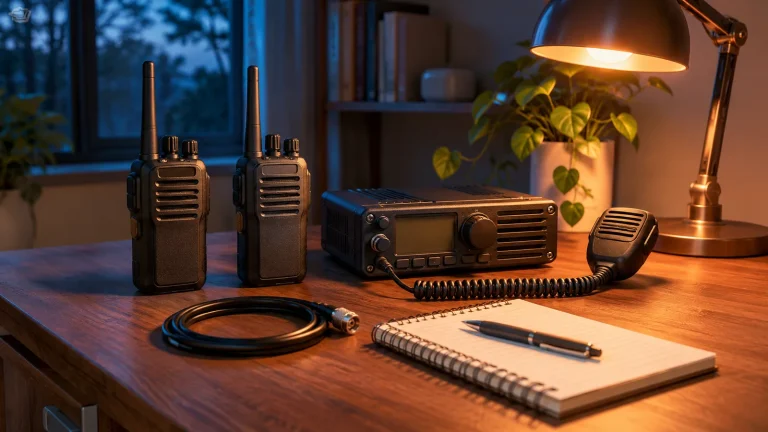
Radio communication is the only reliable information channel when cellular infrastructure fails. In a regional emergency — hurricane, earthquake, grid failure — cell towers are either physically damaged, powered down, or saturated with call volume within hours. Amateur (HAM) radio and the General Mobile Radio Service (GMRS) operate on licensed radio frequencies that require no infrastructure beyond a radio and line of sight (or a repeater). This guide covers the licensing decision, equipment selection, programming, and operational procedures that produce working emergency communication from day one.
The Licensing Decision: HAM vs GMRS
Two licensed radio services serve preppers: Amateur Radio (FCC Part 97) and GMRS (FCC Part 95E). They differ in licensing requirements, allowed power, frequency access, and capability ceiling:
| Feature | GMRS | HAM Technician | HAM General/Extra |
|---|---|---|---|
| License cost | $35 (10-year family license) | $35 FCC fee + exam fee (usually $15 or less) | Exam fee per session (usually $15 or less) |
| Exam required | No | 35-question written exam | Additional exam elements |
| Family coverage | Yes — one license covers immediate family | No — individual license | No |
| Maximum transmitter power | Up to 50W on main channels (less on interstitial channels) | 1,500W PEP (200W PEP on its HF segments) | 1,500W PEP |
| Repeater access | GMRS repeaters only | All amateur repeaters | All amateur repeaters |
| HF (long-range) access | No | Limited: 10m voice at 28.300–28.500 MHz, plus CW segments on 80m, 40m and 15m | Wide HF access (General has band segments; Extra has all) |
| Digital modes | Limited | Full digital modes (Winlink, APRS) | Full digital modes |
| Emergency networks | Limited | ARES, RACES, ARRL EMCOMM | Full EMCOMM participation |
GMRS is better if: You want simple family communication within a neighborhood or rural property, don’t want to study for an exam, and your communication needs are primarily voice within a few miles (or to a GMRS repeater). The Midland MXT115 and similar GMRS radios are plug-and-play.
HAM Technician is better if: You want access to the established amateur repeater network, digital modes (Winlink email over radio, APRS position tracking), and the ability to communicate regionally in organized emergency networks (ARES/RACES). The Technician license unlocks significantly more capability than GMRS at the cost of a 35-question exam with a free question pool.
HAM Technician License: Study Path
The Technician exam consists of 35 questions drawn from a published question pool of 409 questions (the 2026–2030 pool, in effect July 1, 2026 through June 30, 2030). The pool is publicly available — you can study the exact questions and answers that will appear on the exam. Passing score: 26 correct out of 35 (74%).
30-day study path:
- Days 1–20: Study on HamStudy.org (free, tracks your progress per question, identifies weak areas). 20–30 minutes per day. The site uses spaced repetition — it shows you questions you’ve missed more frequently. Target: score above 90% on practice exams before scheduling the real test.
- Days 21–25: Focus on the three most heavily tested topic areas: operating procedures (Q signals, phonetic alphabet, repeater etiquette), electrical principles (Ohm’s law, antenna basics), and FCC regulations (Part 97 rules, prohibited communications).
- Days 26–30: Take timed practice exams simulating real test conditions. When you consistently score 90%+ on 5 consecutive practice exams, you’re ready.
Finding a VE session: Volunteer Examiner sessions are administered by amateur radio clubs. Search the ARRL session finder (arrl.org/find-an-amateur-radio-license-exam-session) or the W5YI Group website for sessions in your area. Sessions are available in person and online (remote proctored exams). The exam fee is set by the VEC and is usually $15 or less. You also pay the FCC a separate $35 application fee. Results are available same day at in-person sessions; the FCC grants the license after the fee is paid, and you can transmit once your call sign appears in the FCC ULS database.
Equipment: The Baofeng UV-5R and Its Alternatives
The Baofeng UV-5R is a widely purchased entry-level HAM radio for preppers. Its FCC equipment authorization lists 136–174 MHz and 400–480 MHz and a maximum power of 1.78 watts for the UV-5R V2+, according to a 2018 FCC enforcement action (DA 18-801). Box and listing claims of 5W don’t match that figure. It will program to most amateur repeaters and simplex frequencies.
Baofeng UV-5R limitations:
- Audio quality is mediocre compared to Yaesu and Icom handhelds
- Frequency stability is lower than commercial-grade radios — can drift under temperature extremes
- Spurious emissions may exceed FCC limits in some configurations. The licensee is responsible for a compliant signal, so this matters even in an emergency.
- Menu-driven programming is counterintuitive without the CHIRP software (free, cross-platform programming software that makes mass-programming straightforward)
Better alternatives:
- Yaesu FT-60R: Significantly better receive sensitivity, rugged construction, wider frequency reception (including weather radio). The most widely recommended step up from Baofeng for serious prepper use.
- Yaesu FT-70DR: Adds System Fusion digital voice mode, which provides clearer audio and GPS position data over digital-enabled repeaters. Useful in areas with System Fusion repeater infrastructure.
- Icom IC-V86: Simple, durable, excellent audio quality for VHF only.
Programming the Baofeng UV-5R with CHIRP
CHIRP (chirpmyradio.com) is free software that programs the Baofeng via a Kenwood-compatible programming cable. Programming sequence:
- Download CHIRP, install the Baofeng UV-5R driver, connect radio via USB programming cable
- In CHIRP: Radio → Download from Radio (pulls current settings into CHIRP)
- Add channels in the channel table: frequency, CTCSS/DCS tone for repeaters, duplex offset (+ or – for repeater offset)
- Program NOAA weather radio frequencies (162.400–162.550 MHz) as receive-only channels for weather monitoring
- Upload back to radio: Radio → Upload to Radio
Repeaters: Range Extension and the Local Network
Repeaters are community-maintained transceivers installed on high points (buildings, towers, hilltops) that receive a signal on one frequency and simultaneously retransmit it on another, extending the effective range of handheld radios well beyond what they reach direct. How far depends on the repeater’s height and your terrain.
Repeater frequency pairs use a standard offset by band:
- 2m (144–148 MHz): Standard offset +/- 600 kHz. If the repeater output (what you receive) is 147.300 MHz, you transmit on 147.900 MHz (+ offset).
- 70cm (440–450 MHz): Standard offset +/- 5 MHz
Most repeaters require a CTCSS tone (Continuous Tone-Coded Squelch System) — a sub-audible tone transmitted along with your voice that the repeater uses to distinguish your signal from interference. The tone frequency (67.0–254.1 Hz) is specific to each repeater. Find local repeaters and their tones at RepeaterBook.com (searchable by zip code) or RadioReference.com.
Emergency Communication Frequencies
Standard calling and emergency frequencies by band:
- 146.520 MHz (National 2m simplex calling frequency): The primary channel to monitor when all repeaters are down or unavailable. Simplex means direct radio-to-radio without a repeater. Range is shorter and depends on terrain, but it needs no infrastructure.
- 446.000 MHz (National 70cm simplex calling frequency): Secondary calling channel. Shorter range than 2m but better building penetration.
- Local ARES/RACES net frequencies: These vary by county. Get them from your local ARES group and program them before you need them.
- NOAA Weather Radio (162.400–162.550 MHz): National Weather Service broadcasts on 7 frequencies — program all 7 as receive-only channels.
FCC Part 97: The Rules That Matter for Preppers
Five Part 97 rules matter most for emergency use:
- No encrypted transmissions: Amateur stations may not send messages encoded to obscure their meaning. The encoding ban has no emergency carve-out of its own. The one emergency override in Part 97 is 47 CFR 97.403, which covers communication about the immediate safety of human life and immediate protection of property when normal systems are not available. The FCC has published no guidance on how it applies to encoding, so don’t plan on it.
- No commercial content: HAM radio cannot be used for business communications. Using your call sign to coordinate commercial activity is a Part 97 violation.
- Station identification: Identify with your FCC-assigned call sign at the end of each communication and at least every 10 minutes during extended transmissions.
- Power limits: An amateur station must use the minimum transmitter power necessary to carry out the communication. It is a rule (47 CFR 97.313(a)), so treat it as a requirement.
- Emergency communications exception: 47 CFR 97.403 lets an amateur station use any means at its disposal for essential communication about the immediate safety of human life or immediate protection of property when normal communication systems are not available. The rule is written for amateur stations; it is not a general license for unlicensed people to operate on amateur frequencies, and it does not cover routine grid-down chatter.
Where to Go Next
The specific Technician license study path — HamStudy.org workflow, question pool breakdown, and VE session process — is in getting your Technician HAM license in 30 days. The GMRS vs HAM comparison with specific radio recommendations for family emergency communication is in GMRS vs HAM radio: which one do preppers actually need. Water communication is the first chain in the emergency supply stack — see water purification without boiling for the procurement methods that precede all other prep.
Corrected 21 November 2026: the Baofeng UV-5R frequency range and power now follow the FCC’s 2018 enforcement record, and the encoding rule now names the 47 CFR 97.403 emergency provision.