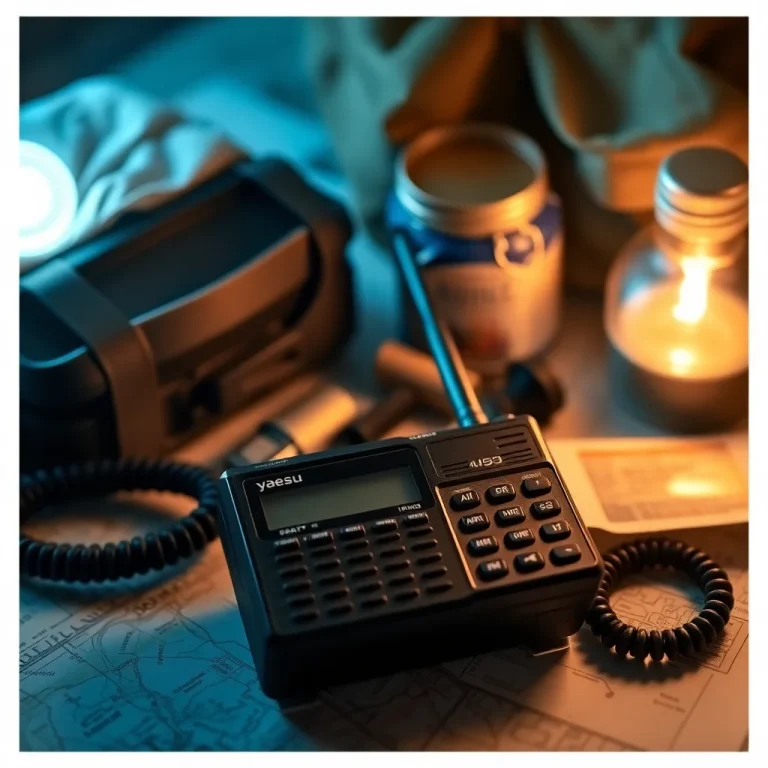
The Technician license is the entry point to amateur radio and the most useful license tier for preppers. It unlocks VHF and UHF operation — the frequencies used by most local emergency networks, all APRS digital infrastructure, Winlink email-over-radio gateways, and the national simplex calling frequencies. The exam is 35 questions from a published 412-question pool. Passing is realistic in 30 days or less with focused study. The complete HAM radio overview is in HAM radio for preppers: license study, setup, and emergency use.
The Question Pool: What You’re Actually Learning
The FCC Technician question pool contains 412 questions organized into 10 topic groups (subelements T1 through T0). The exam draws 35 questions — one from each of the 35 specific subgroups within the 10 subelements. Every question and its correct answer is publicly available at the ARRL website and on HamStudy.org.
Subelement breakdown by question count on the exam:
| Subelement | Topic | Exam questions |
|---|---|---|
| T1 | FCC Rules, station license, control operator | 6 |
| T2 | Operating procedures | 3 |
| T3 | Radio wave characteristics, propagation | 3 |
| T4 | Station setup, equipment operation | 2 |
| T5 | Electrical principles (Ohm’s law, power, capacitance) | 4 |
| T6 | Electronic components | 4 |
| T7 | Station equipment, repair | 4 |
| T8 | Modulation, special operations | 4 |
| T9 | Antennas, feed lines | 2 |
| T0 | RF safety, electrical safety | 3 |
The three subelements with the most exam questions are T1 (FCC rules, 6 questions) and T5/T6/T7/T8 (electrical and equipment, 16 questions combined). If you run out of study time, prioritize T1, T5, and T2 — they account for 13 of the 35 exam questions.
HamStudy.org: The Study Tool That Works
HamStudy.org (free, no account required for basic use) is the most effective study tool for the Technician exam because it implements spaced repetition — it shows you questions you’ve gotten wrong more frequently than questions you’ve answered correctly. This targets study time at weak areas rather than re-reviewing material you already know.
Study workflow:
- Days 1–3: Take a diagnostic practice exam (Start → Practice Exam) without studying first. Note your score and which subelements you got most wrong. This tells you where to focus.
- Days 4–18: Use “Study” mode in HamStudy — it presents flashcards for each question, shows the correct answer, and tracks your performance. Work through all 412 questions at least once. Focus extra time on your lowest-performing subelements.
- Days 19–25: Switch to practice exam mode — 35-question timed exams simulating actual test conditions. Take at least one exam per study session.
- Days 26–30: Continue practice exams until you consistently score 30/35 or higher (86%+). At this level you have meaningful margin above the 74% passing threshold.
Average study time to passing: 8–15 hours total for most students. At 20 minutes per day, this is achievable in 24–45 days.
Three Topics Most Exam-Takers Find Difficult
Ohm’s Law calculations (T5 subelement): The exam includes calculation questions. Ohm’s Law: V = I × R (voltage = current × resistance). Power: P = I × E (power = current × voltage). Know these two formulas and you can solve all math questions in T5. Practice three examples: if a circuit has 12V and 3 ohms resistance, current = 12/3 = 4 amperes. Power = 4 × 12 = 48 watts.
Repeater offsets and CTCSS tones: Know that 2m repeaters use a 600 kHz offset (your transmit frequency is 600 kHz higher or lower than the repeater output frequency); 70cm repeaters use a 5 MHz offset. CTCSS tones are sub-audible tones transmitted with your voice to open the repeater squelch — most repeaters require the correct CTCSS tone or they won’t transmit your signal. The exam does not ask for specific CTCSS tone frequencies but does ask about their purpose.
RF safety exposure limits: The T0 subelement covers Maximum Permissible Exposure (MPE) limits. Key fact: MPE limits are frequency-dependent — VHF frequencies (30–300 MHz) are more restrictive than UHF because human tissue absorbs VHF energy more efficiently. The exam asks about safety distances and actions to take when limits may be exceeded — the answers are generally “increase distance” or “reduce power”.
The VE Session: What to Expect
Volunteer Examiner sessions are administered by teams of at least 3 certified examiners. The exam is a printed paper test (at in-person sessions) or computer-based (online sessions). Requirements to bring:
- Government-issued photo ID
- FRN (FCC Registration Number) — obtain free from fcc.gov/tools/CORES (takes 5 minutes). Using your Social Security Number is permitted but your FRN is preferred and keeps your SSN off FCC records.
- Exam fee: usually $15 cash or check payable to the VE team
Results are typically known immediately after grading at in-person sessions. The VE team submits your passing results to the FCC electronically, and your license appears in the FCC ULS database within 1–3 business days. You can legally operate under Part 97 as soon as your call sign appears in the ULS database — you do not need to wait for a physical license.
What the Technician License Allows
- All VHF and UHF amateur frequencies (50 MHz and above) — including the 2m and 70cm bands used by most local repeaters and emergency nets
- 10m HF band phone (voice) with restrictions — 28.300–28.500 MHz only for voice; useful for long-range regional communication without a General license
- Digital modes on all Technician frequencies — APRS (position tracking), Winlink (email over radio), and all other digital operating modes
- Access to all amateur repeaters — both 2m and 70cm repeater systems nationwide
The General license adds full HF access (160m–10m bands) — critical for long-range (100–3,000 mile) communication without repeaters. If you plan to operate HF for regional or national emergency communication, the General license is the next step after Technician. The General exam is another 35 questions from a published pool, studied the same way.
Where to Go Next
The complete HAM radio setup guide — equipment selection, Baofeng programming with CHIRP, repeater programming, and emergency frequencies — is in HAM radio for preppers: license study, setup, and emergency use. If you’re deciding between GMRS and HAM before committing to the exam, the comparison is in GMRS vs HAM radio: which one do preppers actually need.