Active shooter events and terrorism are statistically rare but require a different preparation framework than natural disasters: the window for action is measured in seconds, not hours, and the correct response changes rapidly as the situation evolves. Run-Hide-Fight is the civilian response taught in federal guidance from DHS and the FBI. This guide covers that protocol and adds the medical response that matters in the minutes before help arrives: stopping life-threatening bleeding, which the American College of Surgeons calls the leading preventable cause of death after injury.
Run-Hide-Fight: The Core Protocol
The DHS Run-Hide-Fight framework presents three options in order of preference:
Run (First Priority)
If there is an accessible escape path and the shooter is not between you and the exit:
- Evacuate regardless of whether others agree to follow
- Leave belongings behind; a bag slows you down
- Help others escape if it does not slow your movement significantly
- Once outside, keep moving away from the building — do not stop near the exit where people exiting may obstruct emergency responders or become secondary targets
- Prevent others from entering the area you just fled
- Call 911 when safely away — provide location, number of shooters if known, physical description, type and number of weapons observed
Hide (Second Option)
If evacuation is not possible — the shooter is between you and exits, or exits are not accessible:
- Move to a room that can be locked or barricaded; close and lock all windows and doors
- Barricade the door with heavy furniture (desk, filing cabinet, couch)
- Turn off lights; silence phones completely (vibration is audible in a quiet room)
- Move away from the door; crouch behind solid furniture
- Remain silent and do not open the door for anyone until law enforcement gives an all-clear — shooters have used fire alarms and calls of “help” to flush people from hidden positions
Fight (Last Resort)
When the shooter enters your location and there is no other option:
- Act with extreme aggression — hesitation reduces effectiveness
- Improvised weapons: fire extinguisher (spray then strike), chair legs, laptop computers, hot liquids, anything that can be thrown or used as a bludgeon
- Commit fully — a half-hearted response against an armed attacker is the worst outcome
- Multiple people attacking simultaneously from different directions is significantly more effective than one-on-one
Public Venue Situational Awareness
The most important active shooter preparation happens before any incident:
- Identify exits upon arrival: At any public venue — restaurant, theater, stadium, airport — identify the two nearest exits within the first minute of arrival. Not the entrance you came in (everyone knows that one), but secondary exits: service doors, emergency exits, kitchen exits.
- Seating preference: In restaurants and theaters, seats with walls to the back and visibility toward entrances provide earlier warning and better cover options.
- Cover vs. concealment: Cover stops bullets (concrete pillars, engine blocks, steel dumpsters). Concealment only hides you (interior walls, car doors, bushes). In an active shooter situation, seek cover, not just concealment.
STOP THE BLEED: Hemorrhage Control
The Hartford Consensus, first convened by the American College of Surgeons in 2013 after the Sandy Hook shooting, found that preventable deaths in mass casualty events are primarily due to uncontrolled hemorrhage. CISA notes that active shooter incidents are often over within 10 to 15 minutes, before police arrive, and a person can die from blood loss within five minutes. Bystander hemorrhage control in that window saves lives.
The STOP THE BLEED program (stopthebleed.org) teaches three escalating responses:
- Direct pressure: For wounds that are not on a limb or cannot be tourniqueted. Pack the wound with gauze or the cleanest cloth available. Apply firm, continuous pressure — do not release to “check” the wound (this disrupts clot formation). Keep pressing until help takes over.
- Wound packing: For deep wounds, pack gauze (Quikclot or plain gauze) tightly into the wound using fingers, packing layer by layer until the wound is full, then apply direct pressure. The goal is to fill the wound cavity and apply pressure against the bleeding source.
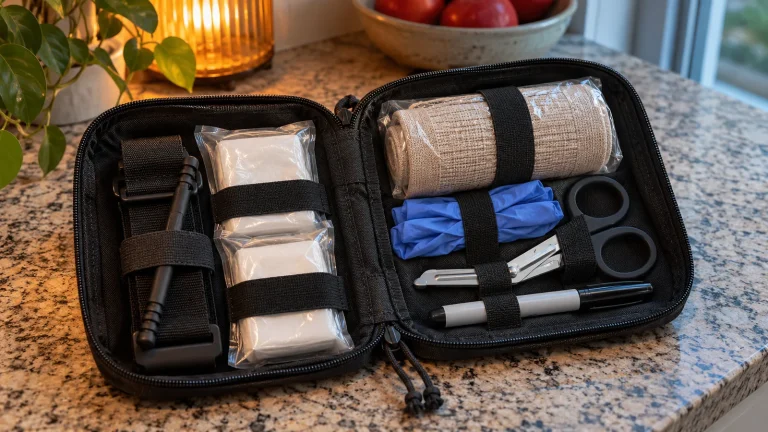
- Tourniquet (for limb wounds): Apply 2–3 inches above the wound on the limb, not on a joint. Tighten until bleeding stops (this requires tight enough pressure to cause significant pain — undertightening a tourniquet is ineffective). Mark the time of application. Use a commercial tourniquet (CAT or SOFTT-W) — improvised tourniquets (belts, zip ties) frequently fail to stop arterial bleeding.
A basic trauma kit (tourniquet + hemostatic gauze + chest seal + gloves + marker) fits in a pocket or small pouch. More detailed TCCC techniques are in wilderness first aid and TCCC.
IED and Suspicious Package Recognition
CISA‘s test for a suspicious item is HOT: Hidden (out of sight or deliberately concealed), Obviously suspicious (unexplained wires, electronics or bomb-like parts), and not Typical for the location. For mailed packages, a common memory aid (not a DHS term) is WHEN:
- Wires, tape, or antennas protruding from a package
- Heavy for its size; wet stains; unusual smell
- Excessive postage; no return address; handwritten or poorly typed labels
- Not expected — delivered when no package was anticipated, especially in unusual locations
If you observe a suspicious package: do not touch it, do not use radios or cell phones near it (RF can trigger some detonators), move away and keep others away, call 911 immediately.
Vehicle Attacks
Vehicle attacks in pedestrian areas (Nice 2016, New York 2017, Berlin 2016) require a different awareness framework than firearms events:
- Move perpendicular to the vehicle’s direction of travel — a vehicle continues in its direction of momentum; moving 90 degrees removes you from its path more quickly than running away from it
- Get off the road surface entirely — behind jersey barriers, bollards, large trees, or inside a building
- At events ringed with vehicle barriers (bollards, concrete blocks), stay inside the barrier line
Where to Go Next
Comprehensive tourniquet application and wound packing technique — including the TCCC principles used by military combat medics — is in wilderness first aid and TCCC: tourniquet application, wound packing, and burn treatment. Home security layers for high-threat environments are in home security grid-down: perimeter layers, access control, and security protocols.