Fifteen emergencies are field-treatable with the right knowledge and minimal equipment. The ones most likely to kill you in a wilderness or grid-down scenario are not exotic — they are bleeding, environmental temperature extremes, anaphylaxis, and fractures that prevent self-evacuation. Each has a specific treatment protocol. This article covers the protocols; the cluster articles cover wound care, fracture management, and environmental emergencies in full detail.
The MARCH Protocol: Field Triage Priority Order
Military and wilderness medicine both use a priority-ordered assessment called MARCH: Massive hemorrhage (control life-threatening bleeding first), Airway (ensure the airway is open), Respiration (treat chest injuries), Circulation (assess and treat shock), Hypothermia (prevent and treat). The order is not arbitrary — uncontrolled bleeding kills in 3–5 minutes, while a compromised airway kills in 4–6 minutes. Temperature problems kill over hours. Always address the fastest killers first.
Emergency 1 — Severe External Bleeding: Tourniquet Application
A tourniquet is the definitive treatment for life-threatening extremity bleeding. Apply a CAT (Combat Application Tourniquet) or similar windlass-style tourniquet 2–3 inches (5–7.5cm) above the wound — not over a joint. Tighten the windlass until bleeding stops completely, then secure the windlass. Write the time of application on the tourniquet or on the patient’s forehead with a marker. A tourniquet applied correctly and documented allows medical providers to make informed decisions about removal.
Do not remove a tourniquet in the field. Research and clinical evidence show that correctly applied tourniquets maintained for up to 2 hours rarely cause permanent nerve or tissue damage. The concern about tourniquet damage is vastly outweighed by the risk of bleeding to death if it is removed prematurely.
For wounds where a tourniquet cannot be applied (junctional wounds at the groin, axilla, neck): apply hemostatic gauze — QuikClot Combat Gauze or Celox Gauze — packed tightly into the wound and held with direct pressure for a minimum of 3 minutes. The hemostatic agent accelerates clot formation; pressure maintains the clot.
Emergency 2 — Wound Care: Irrigation and Closure
Clean wounds prevent infection. The standard field irrigation method: a 60mL syringe with an 18-gauge catheter tip (or a small plastic bag with a pinhole) delivers saline or clean water at approximately 8 psi — enough force to physically flush debris and bacteria from the wound without damaging tissue. Irrigate with at least 100–200mL of fluid per inch of wound length.
Wound closure options by severity:
- Steri-Strips or wound closure strips: For clean lacerations under 1 inch with clean edges. Dry the skin, apply butterfly strips perpendicular to the wound, pulling edges together. Change every 3–5 days.
- Super glue (cyanoacrylate): Medical cyanoacrylate (Dermabond) or commercial super glue works for clean, dry, low-tension lacerations. Apply along the wound edges (not inside the wound) and hold for 30–60 seconds.
- Field sutures: For gaping wounds that cannot be closed with strips. Requires a suture kit with needle driver, forceps, and appropriate suture material (3-0 nylon for extremity skin). Suture skill requires practice — performing field sutures for the first time on an actual wound produces poor results.
Do not close wounds that are more than 6 hours old (primary closure risk of sealing in infection), wounds from animal bites (high infection risk), or deep puncture wounds (anaerobic infection risk). Leave these open, irrigate, pack loosely with gauze, and seek evacuation. Full wound care protocol is in field wound care and infection prevention.
Emergency 3 — Penetrating Chest Trauma: Chest Seal Application
A penetrating chest wound (stab, gunshot, or impalement) can cause a tension pneumothorax — air entering the chest cavity through the wound collapses the lung on that side and eventually compresses the heart. Signs: difficulty breathing, diminished breath sounds on one side, tracheal deviation toward the unaffected side, and rapid deterioration.
Field treatment: apply a vented chest seal (Hyfin Vent, HALO chest seal) over the wound, creating a one-way valve that allows air out but prevents air in. If no chest seal is available, a clean plastic bag taped on three sides works as a functional improvised seal. If the patient deteriorates despite a sealed wound, consider needle decompression — a skill requiring specific training beyond the scope of this article.
Emergency 4 — Fractures: Immobilization and Neurovascular Assessment
The goal of field fracture management is immobilization, not reduction. Do not attempt to straighten fractured bones unless the limb is pulseless and cold below the fracture — in that case, gentle traction and realignment may restore blood flow, but this is a last resort requiring specific training.
Neurovascular check (CSM) before and after splinting — Circulation, Sensation, and Movement:
- Circulation: Pulse, skin color, and temperature distal to the fracture. Compare injured side to uninjured side.
- Sensation: Can the patient feel light touch distal to the fracture? Numbness indicates nerve compression.
- Movement: Can the patient move fingers or toes on the injured extremity? Inability indicates nerve or tendon involvement.
Splinting in detail is in improvised splints and fracture management in the field.
Emergency 5 — Spinal Injury Precautions
Any mechanism involving significant force to the head, neck, or back — fall from height, vehicle accident, dive into shallow water, lightning strike, or avalanche — warrants spinal precautions. Signs of potential spinal injury: pain along the spine, numbness or tingling in extremities, weakness or paralysis, altered consciousness after head trauma.
Field spinal management: minimize movement of the head, neck, and spine. If movement is required (to evacuate from a hazard), maintain alignment with the body as a unit — log roll technique with manual head stabilization by one person and coordinated body roll by two or more. A cervical collar can be improvised from a sleeping pad or foam pad wrapped and taped around the neck, but improvised collars are not reliable without training.
Emergency 6 — Hypothermia: Four Stages and Treatment
Hypothermia is classified in four stages by core temperature:
- HT-I (Mild, 98.6–91°F / 37–33°C): Shivering, cold extremities, poor fine motor coordination. Treatment: remove wet clothing, add insulation, warm shelter, hot beverages if conscious and able to swallow.
- HT-II (Moderate, 91–82°F / 33–28°C): Shivering stops. Muscle stiffness, drowsiness, poor judgment. Treatment: handle gently — cardiac arrhythmia risk begins here. Horizontal positioning, insulation from all sides, no exercise, no alcohol. Heating pad to axilla and groin (high blood-flow areas) if available.
- HT-III (Severe, 82–68°F / 28–20°C): Unconsciousness, minimal vital signs, rigid muscles. Treat as potentially viable — profound hypothermia patients have been successfully resuscitated. “Not dead until warm and dead.” Continue CPR if no pulse; move gently to prevent arrhythmia.
- HT-IV (Death, below 68°F / 20°C): Cessation of cardiac activity.
Rewarming in the field: passive rewarming (insulation, shelter, body-to-body heat) is appropriate for HT-I and HT-II. Active rewarming (chemical heat packs, warm IV fluids) requires medical training and equipment for HT-III. Full treatment protocol is in recognizing and treating hypothermia, hyperthermia, and shock.
Emergency 7 — Heat Stroke: The 104°F Threshold
Heat stroke requires emergency cooling. The critical threshold: core temperature above 104°F (40°C) causes central nervous system dysfunction. Above 106°F (41°C), permanent brain damage and death become likely within minutes. Distinguish heat stroke from heat exhaustion:
- Heat exhaustion: Heavy sweating, weakness, dizziness, nausea. Skin is cool and moist. Core temperature elevated but typically below 104°F. Treatment: rest in shade, oral hydration, cool wet cloths.
- Heat stroke: Altered mental status (confusion, agitation, loss of consciousness). Skin may be hot and dry (classic heat stroke) or hot and wet (exertional heat stroke). Core temperature above 104°F. Treatment: immediate aggressive cooling — cold water immersion (most effective) or ice packs to neck, axilla, and groin. Do not give oral fluids to an unconscious patient.
Emergency 8 — Anaphylaxis: Epinephrine and Positioning
Anaphylaxis is a life-threatening allergic reaction affecting multiple body systems simultaneously. Onset is typically within 5–30 minutes of exposure to the trigger. Signs: hives or skin flushing, throat tightening or stridor, difficulty breathing, low blood pressure, rapid pulse, altered consciousness.
Treatment sequence:
- Epinephrine first: 0.3mg epinephrine IM (intramuscular) via auto-injector (EpiPen, Auvi-Q) into the outer mid-thigh. This is the only definitive field treatment. A second dose may be given after 5–15 minutes if symptoms do not improve.
- Position: Breathing difficulty — sitting upright. Shock or low blood pressure — lie flat with legs elevated. Do not let the patient stand or ambulate — cardiovascular collapse risk is high.
- Diphenhydramine (Benadryl): 25–50mg orally as a secondary treatment after epinephrine. This is not a substitute for epinephrine — antihistamines do not reverse bronchospasm.
Anyone with known severe allergies should carry an epinephrine auto-injector in every kit. The prescription cost is significant; manufacturer coupon programs reduce it. Without epinephrine in the kit, anaphylaxis is potentially unsurvivable in a wilderness or extended-care scenario.
Emergency 9 — Burns: Classification and Field Cooling
Burns classified by depth:
- Superficial (first-degree): Red, painful, no blisters. Treatment: cool running water for 10–20 minutes, aloe vera or burn gel, no covering required.
- Partial thickness (second-degree): Blisters, moist red skin, very painful. Treatment: cool water for 10–20 minutes, do not pop blisters (they are natural infection barriers), non-adherent dressing. Blisters that have popped: irrigate, cover with non-adherent gauze (Telfa).
- Full thickness (third-degree): White, brown, or charred skin; painless (nerve endings destroyed). Requires evacuation. Field care: cover with a clean dry dressing. Do not use ice, butter, or household remedies — they cause additional tissue damage.
The Rule of Nines estimates burn surface area: each arm = 9%, each leg = 18%, front torso = 18%, back torso = 18%, head = 9%. Burns covering more than 20% of body surface area require IV fluid resuscitation — a field-impossible intervention. Priority for these patients is rapid evacuation.
Emergencies 10–15: Quick Protocol Reference
| Emergency | Key field action | Critical threshold/number |
|---|---|---|
| Dislocated shoulder | Immobilize in position found; do not attempt reduction without training | Neurovascular check before/after |
| Eye injury (chemical) | Irrigate with clean water for 20+ min, do not rub | 20 minutes minimum irrigation |
| Diabetic emergency (low blood sugar) | 15–20g fast-acting carbs (sugar, glucose tabs) if conscious | 15g carbs → 15 min → recheck |
| Seizure | Protect from injury, do not restrain, do not put anything in mouth | Seizure lasting >5 min = emergency evacuation |
| Lightning strike | CPR if no pulse — lightning victims are safe to touch | Treat cardiac arrest as primary concern |
| Drowning/near-drowning | Rescue breathing, CPR; all near-drowning patients need hospital evaluation | Secondary drowning risk within 24 hours |
The Field Medical Kit: Minimum Viable
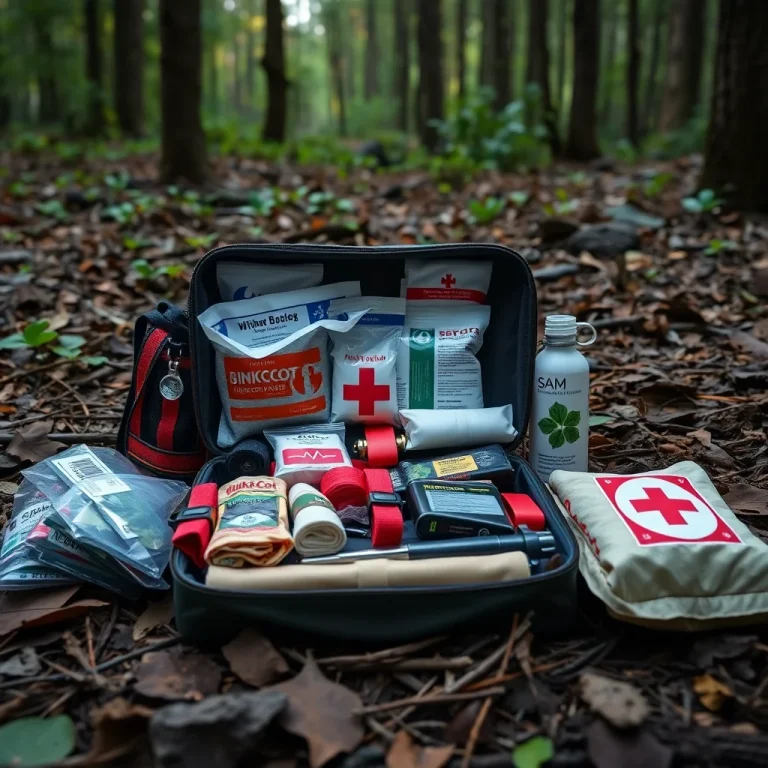
Minimum viable field medical kit for all 15 emergencies above:
- Hemorrhage control: CAT tourniquet, QuikClot Combat Gauze (1 package), Israeli bandage (1)
- Wound care: 60mL irrigation syringe, Steri-Strips, non-adherent gauze (Telfa), medical tape
- Airway/chest: Nasopharyngeal airway (NPA), Hyfin Vent chest seal (1 pair)
- Medications: EpiPen or epinephrine auto-injector (prescription), diphenhydramine 25mg, ibuprofen, loperamide
- Splinting: SAM splint (1), elastic bandage (ACE wrap)
- Reference: Wilderness Medical Society pocket guide or equivalent
Where to Go Next
Field wound care in detail — irrigation pressure, closure technique, and infection recognition — is in field wound care and infection prevention. Fracture assessment, SAM splint application, and traction splint for femur fracture are in improvised splints and fracture management in the field. Hypothermia stages HT-I through HT-IV with rewarming protocol, heat stroke ice bath procedure, and shock management are in recognizing and treating hypothermia, hyperthermia, and shock. For the supplies required to build this kit, see trauma kit (IFAK) for preppers.